0%

Choosing Sweatshirt Manufacturing can give your brand more control over quality, fit, and customer experience. Instead of relying on generic wholesale designs, you can develop garments around your audience’s needs. A heavier fleece may suit winter markets, while a lighter cotton blend can support year-round collections. Small details matter, too. Ribbed cuffs, reinforced seams, accurate sizing, and soft inner brushing can influence repeat purchases.

Reliable manufacturing begins with clear communication and practical evaluation. Experienced production teams can guide fabric selection, pattern development, sampling, and quality checks. They should explain minimum order quantities, production timelines, testing procedures, and possible limitations before you commit. A physical sample is essential. It may reveal uneven stitching, a tight neckline, or a fit that looks different from the original sketch.

No supplier is perfect.

That is worth remembering. Even a carefully planned order may need revisions after washing, printing, or fitting. Strong brands respond by documenting changes and checking each production stage. They also confirm fabric composition, color consistency, packaging details, and delivery expectations in writing. This approach supports dependable sourcing and protects your brand’s reputation over time. When selected thoughtfully, Sweatshirt Manufacturing becomes more than a production method. It becomes a way to build recognizable products, improve customer trust, and create a collection with measurable commercial value. The process requires patience, honest feedback, and decisions based on evidence rather than attractive promises.
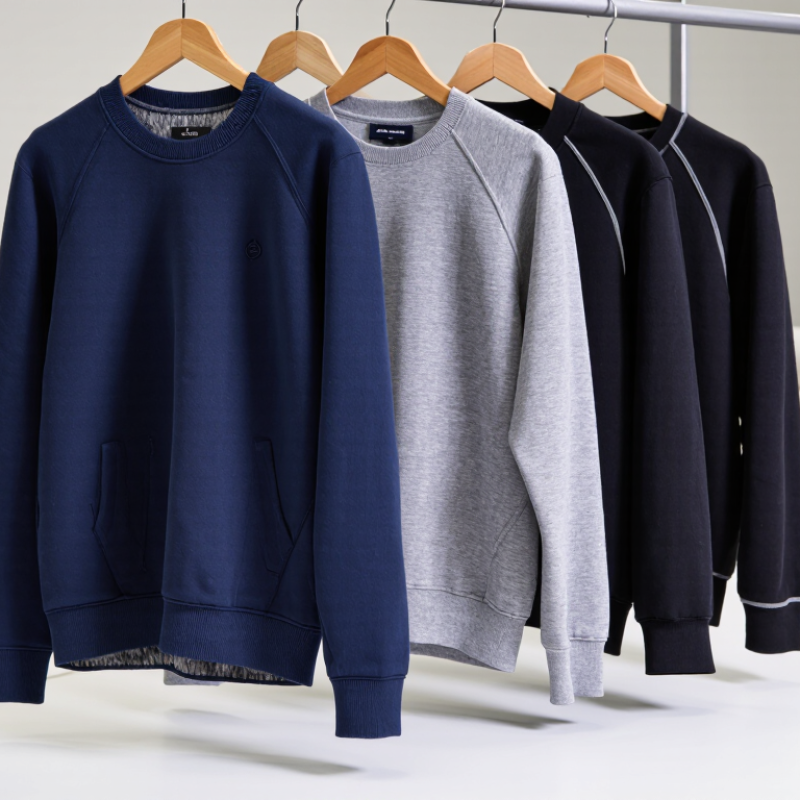
Why Choose Sweatshirt Manufacturing for Your Brand?

What Is Sweatshirt Manufacturing and How Does It Work?

Sweatshirt manufacturing is the controlled process of turning fabric into a wearable, durable garment. It begins with design specifications, fabric selection, pattern development, cutting, sewing, finishing, and quality inspection. Common fabrics include cotton, recycled polyester, and blended fleece. Textile Exchange’s 2024 Materials Market Report states that global fiber production reached 124 million tonnes in 2023. Polyester represented about 57% of that volume. This figure shows why material choices matter for both cost and environmental impact.

In production practice, technicians first test fabric weight, shrinkage, colorfastness, and stretch recovery. They then create patterns and arrange them to reduce cutting waste. Sewing lines join the body panels, sleeves, cuffs, and waistband. Brushing may create a softer inner surface. Washing and pressing define the final hand feel. However, the process is not perfectly linear. A fabric can pass laboratory tests yet feel uncomfortable after washing. UNEP reports that textiles create approximately 2% to 8% of global greenhouse gas emissions. Small manufacturing decisions therefore deserve careful review, not optimistic assumptions.

Tips: Request a pre-production sample. Measure shrinkage after washing. Check seam strength and pilling. Confirm fiber content with reliable test reports. Keep a production record for every batch. A slightly slower inspection can prevent costly rework. Quality is rarely accidental.

Why Custom Sweatshirt Production Benefits Your Brand

Why Choose Sweatshirt Manufacturing for Your Brand?

Custom sweatshirt production gives your brand stronger control over fit, fabric, color, and decoration. A standard wholesale garment may look acceptable, but it rarely reflects your full product idea. Custom development can create a heavier fleece body, reinforced shoulder seams, or a softer brushed interior. These details affect comfort and repeat purchases.

The business case is also measurable. Textile Exchange’s Materials Market Report 2024 recorded 124 million tonnes of global fiber production in 2023. That figure shows why material selection cannot remain an afterthought. Recycled fibers, certified cotton, and traceable suppliers can reduce sourcing risks. However, custom production is not automatically more sustainable. Small orders may increase sampling, packaging, and transport. In factory reviews, clear specifications usually prevent more waste than attractive promises. The process still needs honest measurement.

Tips: Request a pre-production sample before approving bulk work. Test shrinkage after washing. Check print cracking, cuff recovery, and seam strength. Ask suppliers for fiber documentation and production tolerances. Keep the first collection focused. Too many colors can weaken inventory planning. The perfect specification may not exist. A practical compromise often performs better. Textile Exchange’s report also shows continued pressure on virgin material use, so reviewing fabric blends each season remains sensible. Track returns and customer comments, then adjust the next production run.

Why Choose Sweatshirt Manufacturing for Your Brand?

Consumer research highlights three opportunities that custom sweatshirt production can support: personalization, sustainable purchasing, and environmentally conscious buying behavior.

Custom sweatshirt production allows brands to develop personalized designs, select preferred fabrics and finishes, and produce more targeted collections instead of relying only on standardized products. The figures shown are consumer research findings, not company or brand performance data.

Sources: McKinsey & Company, “The value of getting personalization right—or wrong—for consumers” (2021); IBM Institute for Business Value, “Meet the 2020 consumers driving change” (2020).

How to Select Fabrics, Designs, and Production Specifications

Selecting the right sweatshirt fabric starts with the customer’s daily routine. A 300 GSM cotton blend feels substantial without becoming overly heavy. Brushed fleece adds warmth, while French terry offers better breathability. I usually request fabric swatches before approving bulk production. Touch alone can mislead.

Fiber content affects shrinkage, softness, and care requirements. A cotton-polyester blend may hold its shape better after repeated washing. However, excessive polyester can reduce breathability. Test shrinkage after washing at the intended temperature. Check colorfastness with a damp white cloth. Small tests prevent expensive surprises.

Design decisions should match the fabric’s behavior. Ribbed cuffs need reliable recovery around the wrist. A drop shoulder requires careful grading across different sizes. Specify stitch density, seam width, hood dimensions, drawcord details, and pocket placement. Include measurements for every size, not only the sample. Production sheets should state fabric weight, tolerance ranges, labeling positions, and packing instructions. I once underestimated sleeve length by a few centimeters, and the sample looked acceptable until worn. That mistake showed me why fitting tests need different body types, not just one model. Always inspect pre-production samples under natural light. Too many details can still create confusion. Clear specifications usually produce better results.

How to Evaluate Sweatshirt Manufacturers and Their Capabilities

Choosing sweatshirt manufacturing can give your brand stronger control over fit, fabric, and production quality. Yet the manufacturer matters more than the product category. A reliable partner should show recent samples, factory certifications, quality records, and clear production timelines. Ask who owns the factory, where cutting and sewing occur, and how defects are recorded. A polished sample can still hide weak production controls.

Use industry data to test their claims. Textile Exchange’s 2024 Materials Market Report reported 124 million tonnes of global fiber production in 2023. Polyester represented about 57% of that volume. Ask manufacturers to identify fiber content, recycled inputs, and certification evidence. The McKinsey and Global Fashion Agenda report estimated fashion creates about 2.1 billion tonnes of greenhouse-gas emissions annually. Therefore, energy use, dyeing methods, wastewater controls, and packaging deserve direct questions. Request measurable data, not general promises. Also compare minimum order quantities, size grading, shrinkage testing, colorfastness, and capacity during peak seasons.

Tips: Build a simple supplier scorecard. Give quality, compliance, communication, capacity, and sustainability separate scores. Visit the facility when possible. Speak with production managers, not only sales staff. Check one full production run before scaling. I would avoid choosing the lowest quote automatically. It may reduce initial cost, but hidden rework can damage margins. No scorecard is perfect. Review it after every shipment.

What Are the Main Stages from Sampling to Final Delivery?

Choosing sweatshirt manufacturing for your brand can offer practical control over fit, fabric, and production quality. The process begins with a clear tech pack, including measurements, artwork placement, stitching details, and packaging needs. A factory then checks the fabric weight, fiber blend, shrinkage, and color before preparing the first sample. This early review prevents expensive mistakes later.

The first sample is tested on a real person, not only against a measurement chart. We check shoulder width, sleeve length, hood shape, rib recovery, and comfort after movement. Small details matter. A sample may look correct but feel too tight at the cuffs. Revisions are normal, and sometimes the second version still needs work. After approval, the factory confirms the pre-production sample and orders the required materials. Cutting follows the graded size pattern, while sewing teams assemble panels under controlled specifications.

Quality checks continue during production. Inspectors review seam strength, print position, loose threads, stains, and measurement tolerances. They may also test shrinkage after washing. Final inspection compares finished pieces with the approved sample, including labels, folding, and carton quantities. Garments are packed in dry cartons with clear shipping documents. Delivery depends on production timing, inspection results, and transport capacity. Dates can move. Honest communication matters more than promising an unrealistic schedule.

Why Choose Sweatshirt Manufacturing for Your Brand? - What Are the Main Stages from Sampling to Final Delivery?

Manufacturing Stage Typical Duration Main Activities Key Quality Checks Brand Benefit Expected Output
1. Product Brief & Design Review 1–3 business days Confirm garment type, fit, fabric weight, color references, decoration method, size range, labels, packaging, and target order quantity. Specification completeness, measurement consistency, artwork resolution, and construction feasibility. Creates a clear production roadmap and reduces avoidable revisions. Approved technical brief and preliminary bill of materials.
2. Fabric & Trim Sourcing 3–10 business days Select sweatshirt fleece or French terry, ribbing, thread, drawcords, labels, hangtags, and packaging materials. Fiber composition, fabric weight, shade, stretch recovery, shrinkage risk, and trim compatibility. Allows the product to match its intended comfort, appearance, and price position. Material swatches, color references, and sourcing confirmation.
3. First Sample Development 5–12 business days Create the initial sample using the proposed pattern, fabric, seam construction, decoration, and finishing details. Overall silhouette, seam placement, collar and cuff fit, decoration position, and workmanship. Provides a physical product for evaluating design intent before bulk commitment. Prototype sample and preliminary measurement report.
4. Fit Review & Sample Revision 3–8 business days per round Review measurements and wearability, then adjust the pattern, proportions, fabric, color, or construction as required. Point-of-measure tolerances, mobility, balance, comfort, wash appearance, and visual accuracy. Improves fit consistency and helps prevent costly bulk-production corrections. Approved fit sample and finalized measurement specification.
5. Pre-Production Approval 2–5 business days Confirm the final sample, grading rules, color standards, decoration artwork, care labels, packaging, and production instructions. Final sample-to-spec comparison, artwork placement, labeling compliance, and packaging details. Locks the approved standard that production teams can follow consistently. Signed-off pre-production sample and production tech pack.
6. Cutting & Panel Preparation 2–5 business days Relax the fabric, prepare markers, cut body panels and trims, and bundle components by size and color. Fabric relaxation, grain direction, shade grouping, cutting accuracy, and panel matching. Supports efficient material use and stable garment dimensions. Organized cut panels ready for sewing.
7. Sewing & Garment Assembly 5–15 business days Assemble the body, attach sleeves, cuffs, waistband, hood or neck components, labels, and other approved details. Seam strength, stitch density, skipped stitches, puckering, symmetry, and attachment security. Transforms approved materials into a consistent finished sweatshirt. Sewn garments ready for decoration and finishing inspection.
8. Printing, Embroidery & Finishing 2–7 business days Apply approved screen printing, embroidery, transfers, patches, washing effects, thread trimming, and loose-thread removal. Artwork size and position, color accuracy, adhesion, embroidery density, and surface cleanliness. Delivers the visual details that support product recognition and collection consistency. Decorated and finished sweatshirts.
9. Final Quality Inspection 1–3 business days Inspect finished garments using approved specifications and sampling procedures before packing. Measurements, fabric defects, stains, seam quality, decoration, labels, color consistency, and quantity. Identifies nonconformities before shipment and protects the intended customer experience. Inspection record, accepted quantity, and corrected or rejected units.
10. Folding, Packing & Documentation 1–3 business days Fold garments, apply individual packaging, sort by size and color, prepare cartons, and complete shipping documents. Packing instructions, carton quantities, barcode or label accuracy, carton condition, and shipment count. Reduces handling damage and simplifies receiving and inventory management. Shipment-ready cartons and commercial documentation.
11. Final Delivery Transit varies by route Arrange the selected freight method, dispatch the order, track transportation, and coordinate delivery to the agreed destination. Tracking information, carton count, delivery condition, and receipt confirmation. Completes the supply chain from approved sample to usable inventory. Delivered order ready for distribution or sale.

FAQS

What does sweatshirt manufacturing involve?

It turns fabric into a finished garment through design, cutting, sewing, finishing, and inspection. The process is controlled, but not perfectly linear.

Which fabrics are commonly used for sweatshirts?

Common choices include cotton, recycled polyester, and blended fleece. Brushed fleece feels warmer, while French terry usually allows better airflow.

How should fabric quality be tested?

Test fabric weight, shrinkage, colorfastness, stretch recovery, and pilling. Wash a sample at the intended temperature. Touch can mislead.

How can fabric choices affect comfort and durability?

Cotton may feel soft but shrink more. A cotton-polyester blend can hold its shape better after repeated washing. Too much polyester may reduce breathability.

What production details should specifications include?

Include measurements for every size, fabric weight, stitch density, seam width, hood dimensions, and pocket placement. Add tolerance ranges and packing instructions.

Why is a pre-production sample important?

It reveals fitting, shrinkage, seam, and color problems before bulk production. Inspect it after washing and under natural light. Small errors grow quickly.

How can a manufacturer’s capabilities be evaluated?

Request recent samples, quality records, factory certifications, production timelines, and defect reports. Ask where cutting and sewing happen. A polished sample proves little.

What should be checked during production?

Inspect seam strength, cuff recovery, color consistency, pilling, measurements, and fabric content. Keep records for every batch. Inspection can feel slow, but rework costs more.

Conclusion

Sweatshirt Manufacturing is the process of turning a garment concept into finished products through coordinated planning, material selection, pattern development, sampling, production, quality control, and delivery. For a growing clothing business, custom sweatshirt production offers greater control over fit, fabric weight, colors, details, and sizing. It also helps create products that reflect a clear design direction while supporting consistent quality and more efficient inventory planning.

A successful project begins with choosing suitable fabrics, construction methods, measurements, trims, and decoration specifications. When evaluating manufacturers, businesses should consider their technical expertise, equipment, communication, sample accuracy, production capacity, quality standards, and ability to meet required timelines. The process usually moves from design review and prototype sampling to revisions, approval, bulk cutting and sewing, finishing, inspection, packing, and final shipment. Careful coordination at every stage can reduce errors, control costs, and ensure the finished sweatshirts meet both performance expectations and customer needs.

Clara

Clara

Clara is a dedicated marketing professional who combines strategic insight, creative communication, and a deep understanding of the company’s products. With extensive experience in market research, content strategy, and customer-focused communication, she plays an important role in presenting the......